The ongoing creation of unique contemporary art never fails to amaze me. When you think it has all been done, new expressions arise. It is this art that inspires me the most.
What the MCA required was simple yet highly complex due to the existing building, early Colonial remains under the site and being located in a historic precinct. Apart from coherent circulation throughout, dedicated education spaces and flexible gallery spaces, the building had to be a contemporary signifier - a building recognisably a contemporary art museum. All these had to serve the art, as it is all about the art and its undistracted display.
Analysis of the solids and voids in the built form of Circular Quay, particularly the Rocks, shows roads running along the contours and narrow passages down between these roads. These provide pedestrian short cuts as well as vistas to the harbour. It is surprising how many there are. This device has been employed in the new building to reconcile the schism of entry levels from Circular Quay and George Street being on different levels. An internal 'street' has been formed to allow easy access and get people to a point from which the gallery experience would commence. Like the narrow passages, views and pedestrian traffic flow through the building.
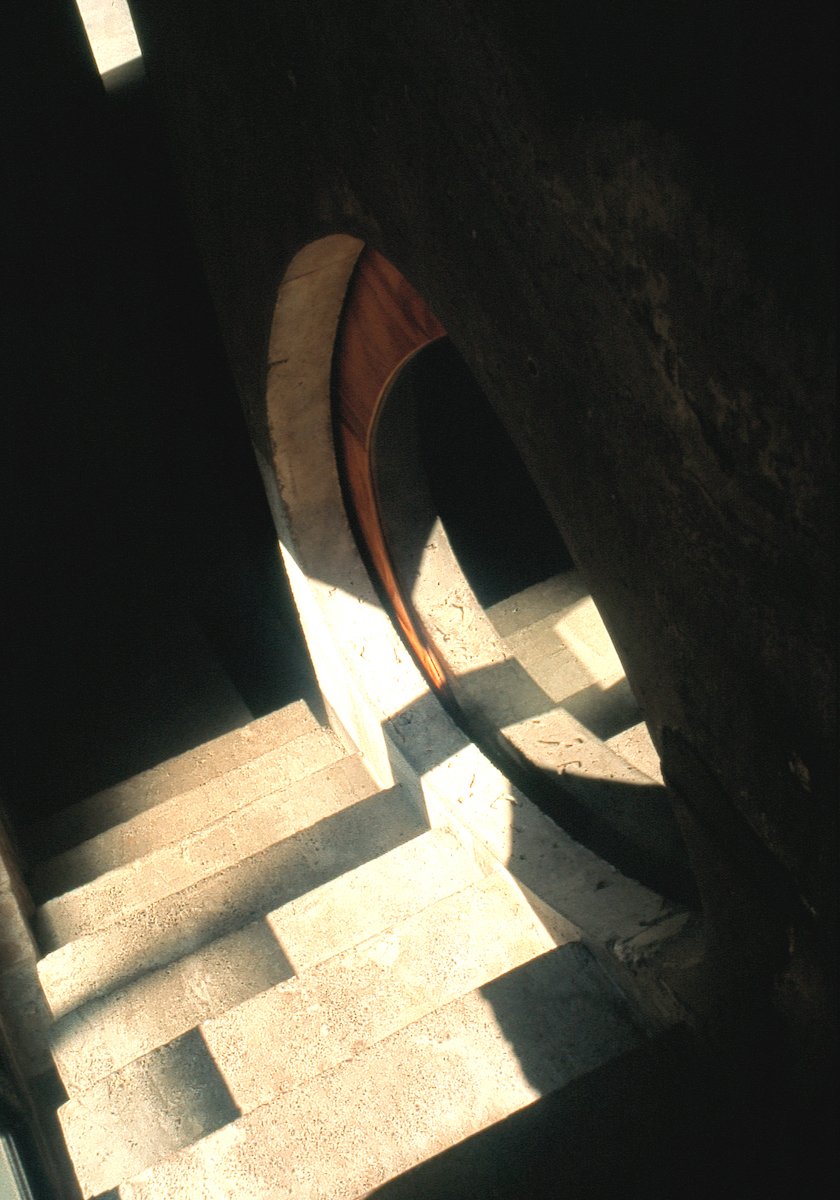
From this 'street', a simple circulation system can be accessed. Although the new building is intentionally pushed up against the old building, the main circulation stair and lifts act as the separation between old and new. Traversing either, one encounters old and new, as well as views in and out.
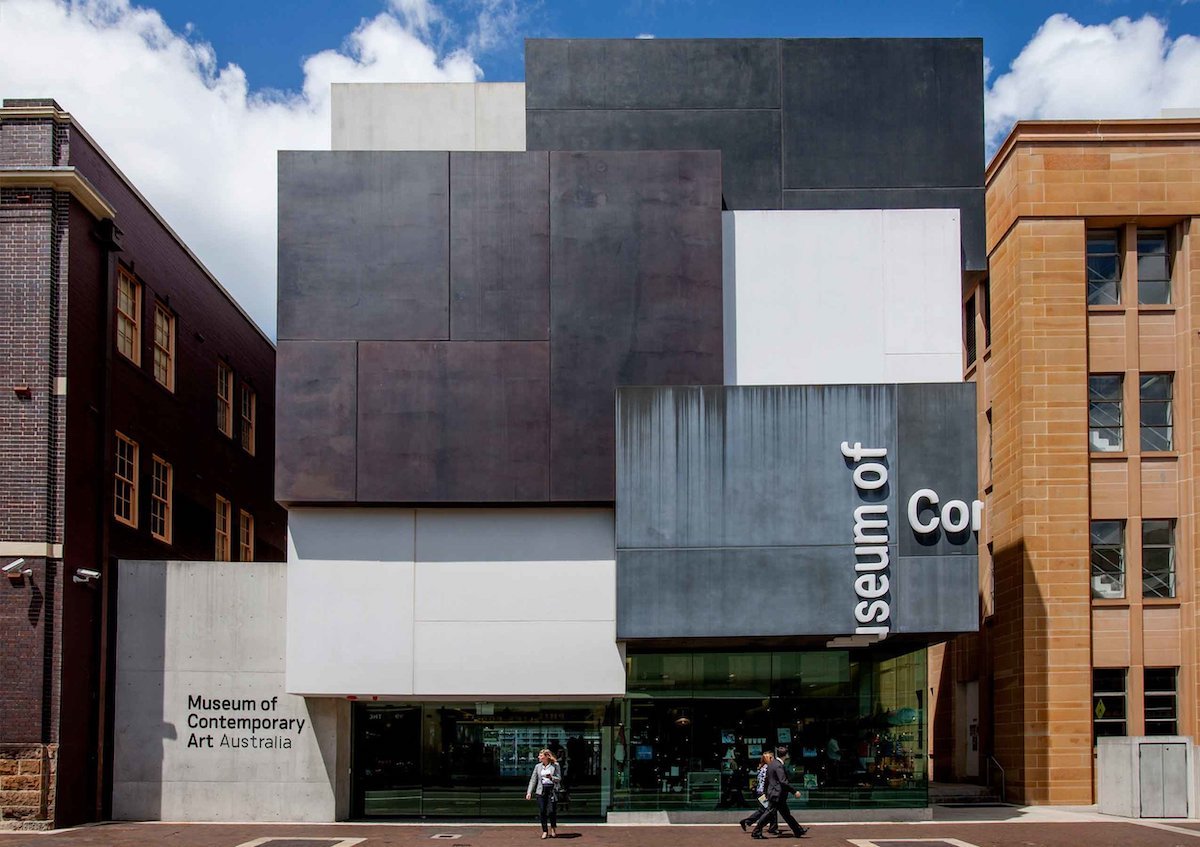
The initial form generator was the white box. The MCA's practice is to create spaces that accommodate the art. They require very simple white box-like spaces that curators can reconfigure. The starting point for the design. The double height gallery on the prominent north-eastern corner is the clearest expression of this idea. Interior white walls and exterior bounding white GRC (glass reinforced cement) are separated from the rest of the building.
Other rooms were designated colours and placed according to function. Spaces between these rooms are for circulation and for views out and in.
The value of a view is questioned. With expansive views available, the temptation would be a glass facade to not miss a glimpse. Instead, the gaps between the boxes are carefully placed to give different rooms different views.
Analysis of the old Maritime Services Board building revealed that it is a composition of forms (or boxes) that are arranged in a conventional and symmetrical fashion. This idea has been reinterpreted in the new addition whereby the boxes are similarly big scale yet assembled in the opposite fashion, ie asymmetrical, to express the MCA's desire for inclusivity.
I have always been fascinated with the dialogue between opposites and in this case solid and void, finite and infinite. Most of my work deals with this. Such gaps provide views out for orientation, interest and relief.
Scale was a very important consideration in the design. The western side of George Street is a very coherent wall of predominantly Georgian and Victorian buildings. But as the eastern side is a mix of later period architecture (including the MCA) and open space, a contemporary gesture did not seem out of place - especially by contrast to the historic western side of the street. I like contrast. Especially when it comes to heritage. A highly contemporary building up against a historic building highlights the heritage and there is no confusion about what is historically important. Trying to fit in or copying period styles would have been vandalism to the original heritage fabric.
Surrounded by the massive scale of the expanse of Circular Quay, the arching span of the Bridge, the huge simplicity of the Opera House, ridiculous Luna Park face and the skyward competition of the towers of the CBD, what could be put next to the strength of the MSB building? As Professor Tom Henegan noted on seeing the design, "What do you put next to a gorilla - another gorilla." The extension had to be strong.
Large scale gestures have been used to articulate the external shape. Considering that the building is seen from all angles including above, an architectural expression that had no front, back nor top was paramount.
Foreseeing that the design could change during the design process, a facade system was developed whereby change could be easily be accommodated and the building's appearance not compromised. The asymmetrical array of boxes and their colours remained strong yet flexible.
GRC cladding panels were used due to the massive sizes they could be fabricated in (9x3m with a 1.5m return) and their ability to be cast in three dimensional forms out of a material only 12mm thick. GRC had the unique quality that it could fold over from the vertical facade to form roofs and ceilings. One cladding material could be used for most of the building - walls, ceilings and roof were one.
Generally materials retain their integrity by resisting being finished in surface coatings. Plasterboard is the exception as it is continually transformed by the MCA. Local materials are used wherever possible. While wanting to have its own language commensurate with the large scale gestures in Circular Quay, the earth colours are both from the surrounds and contrast the surrounds. So the building does not get lost in the surrounds, the contrast of these colours has been turned up full and is in uninterrupted expanses. Brown, white and black are the bookends of the colours with three greys in between. The interior is predominantly white as the neutral background to the art.
Being in a position to inspire others, the MCA's environmentally sustainable design initiatives have gone considerably beyond statutory requirements. The key initiative is a seawater exchange system that reduces emissions and running costs for air conditioning (which is essential for the conservation of the art) by one third.
I look forward to seeing the wonderful contemporary art that will fill the spaces and the way the galleries will be reconfigured by artists and curaters. I anticipate the great parties that will be had with the great views on hand and the fulfilled children and adults who will be inspired by the classes in the education spaces. I welcome the weathering of the building as it settles into the site.